
my blog
Today, 24 March, 2010, is Ada Lovelace Day - a day to celebrate women in science and technology. Ada Lovelace was the only child of Lord Byron and wrote the first programmes for Charles Babbage's Analytical Engine, the first computer. In celebration of Ada Lovelace, women all over the world are committed to writing about their scientific heroines.
I'm a retired anthropologist. When I studied for my undergraduate degree, I took a course in Science and Public Policy, taught by an eminent retired chemist - male. He came to the University of Texas after required retirement at Cornell and he insisted on teaching a limited range of courses: beginning undergraduate chemistry,to see the joys of young students as they discovered the beauty of chemistry; graduate students, to mentor young chemists at the beginning of their career; and the one I took, Science and Public Policy. He thought science was important, fascinating and a social and public good. He thought that while everyone might not be able to do science, almost anyone could understand it. Basic scientific knowledge, about the level offered by a good high school, would make an individual's life more satisfactory.
So he stood in front of an auditorium with three or four hundred students and lectured three hours a week. About half took the course because he was eminent - they knew who he was, he was a Name. About half (including me) took the course because it was a soft option to satisfy UT's science requirement - six semester's course work in a science to get a Bachelor of Arts degree. No one who took the course left without being aware of the passion and imagination that is part of science.
It is, perhaps, odd to begin a blog in honour of Ada Lovelace by discussing a male lecturer. This was in 1968, very much a time of the Two Cultures. One, the scientific one, was considerably more gender blind than the other. I also took a course in the novel. The male lecturer, on the first day of class, said that writing fiction, to be precise, novels, was a male pursuit. There had only been three great female novelists: Jane Austin, George Eliot and Virginia Woolf. The twenty-nine women and one man sitting in front of him obediently wrote this down. And believed it.
I loved geology, tolerated biology and loathed chemistry. But at least no chemistry teacher ever told me I was barred from practicing the disciple by my sex.
I studied anthropology, BA, MA, and PhD. Anthropology is a broad church, and that's what fascinated me about it. Anthropologists, at least in the American branch, try to understand human beings as biological, cultural and social animals. Some anthropologists could fit quite easily into a biology department. Others could join a literature or music department. Anthropology is neat because you can justify investigating anything you want; liberation without license: it is systematic, based on evidence and recorded observation and offers an hypothesis about the relationships between phenomena. It is not journalism or literature or what I did on my summer vacation. What is considered important and how it is analyzed grows out of the body of literature that is part of the discipline.
Women have always been part of the discipline. The great forefathers include foremothers; Margaret Mead, Ruth Benedict, A.I. Richards. They weren't always accepted as part of the academic, university based discipline, but they wrote and they published and, most important of all, they did field work.
Anthropology is fieldwork based. In some societies, women had greater access to informants than males. As outsiders, they could talk to men. As women, they could talk to the women of the group - something male field workers were sometimes prevented from doing. (One of the Great and Good, Evans-Pritchard, in an introduction to one of his books, The Nuer Speak for Themselves, said that he could say very little about women among the Nuer. They had their own skills and occupations, but as a man he could not find out about them. Thus, half of the Nuer population was essentially unstudied.)
So gender roles themselves required both men and women to study a group. Anthropology, and some of the women practicing it, offer satisfactory scientific figures to offer as heroines on Ada Lovelace Day. But my real heroines go back to the very beginning, to the development of science itself.
Every human group has a division of labour; at its simplest, the division of labour is based on sex and age. Age divisions reflect differences in strength and knowledge; in a very general way, divisions based on sex reflect the same thing. The pattern among early human beings involves men hunting and women gathering plant material. Both involve considerable skill.
Imagine those very early groups, those men and women and children who left the African Savannah. As they ranged North, plant and animal life differed. How did they adapt to the cold - how did they deal with the changing seasons after leaving the tropics?
They had fire. They used fire to sear the meat, killing the bacteria on the surface. Cooking meat and grains makes it more digestible. They processed foods - hanging strips of meat in the sun, mixing it with berries to add sugar so it lasts longer. This was women's work, and women's discoveries.
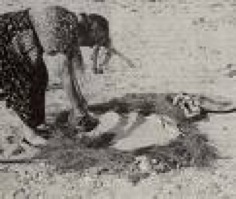
Consider acorn flour. Acorns are big nuts, they store well. They provide protein, carbohydrates and fats. They can be collected efficiently. As groups move into the forest, they could see birds, large and small mammals eating acorns in the fall.
Acorns also contain tannin - bitter, interferes with metabolizing protein, and can make people sick; depending on the variety of oak, they can cause death. The first experience of eating acorns must have been unpleasant. But they're such a useful thing - they don't spoil. They can be stored without molding or rotting. As it grows colder and there's less plant material to eat, acorns become more attractive.
Perhaps those women raided a squirrel cache. Rain leaches the tannin from the stored acorns. These acorns would not be bitter, would not make you sick. Perhaps cooking? Cooking prior to leaching locks the tannin in, leaving the acorns inedible. At some point, women began to shell and chop the acorns, to soak them in water, change the water, soak until the water is clear, no longer brown. The acorns can then be cooked. Think of the experimentation that must have gone on before developing a process that converted a potentially useful material into an actual important food source.
Wheat, rice, cassava, potatoes, yams, sweet corn -- the complex carbohydrates that are the most efficient way to fuel the human body, require processing and women did it. Men provided meat, the high status food, equally necessary - but not equal in quantity. (Exceptionally, the Inuit of the Far North rely on a diet primarily of meat. The Inuit woman is in charge of the great clothing complex that developed to allow survival in the cold; processing and sewing skins. Tanning - another interesting process.)
As people shifted to other ways of obtaining food, slash and burn agriculture, herding animals, women were still in charge of much of the processing of food, making it edible and making it last. Different climates, different environments, required experimentation.
What sort of hypothesis did those early women use? There are too many poisonous plants around to simply gobble anything that grows. Similarity would be an important starting point;. plants that resembled other food, like nuts and berries. People would avoid things that were bitter, that caused the mouth to go numb. Smell, sight, taste; all data to be considered and evaluated.
These early women observed, investigated, experimented and developed processes to deal with the natural world. They were scientists, early scientists, and Ada Lovelace Day is a good time to acknowledge them.

Thursday, 25 March 2010
Ada Lovelace Day
Photo by Norman Wilson, Handbook of North American Indians, U.CA Press. A woman leaching acorns.


